Stay a while!
Please grab some coffee, tea, or your favorite drink and enjoy my work. I’d love to provide some respite for you- that’s why I do this.
Choral
-
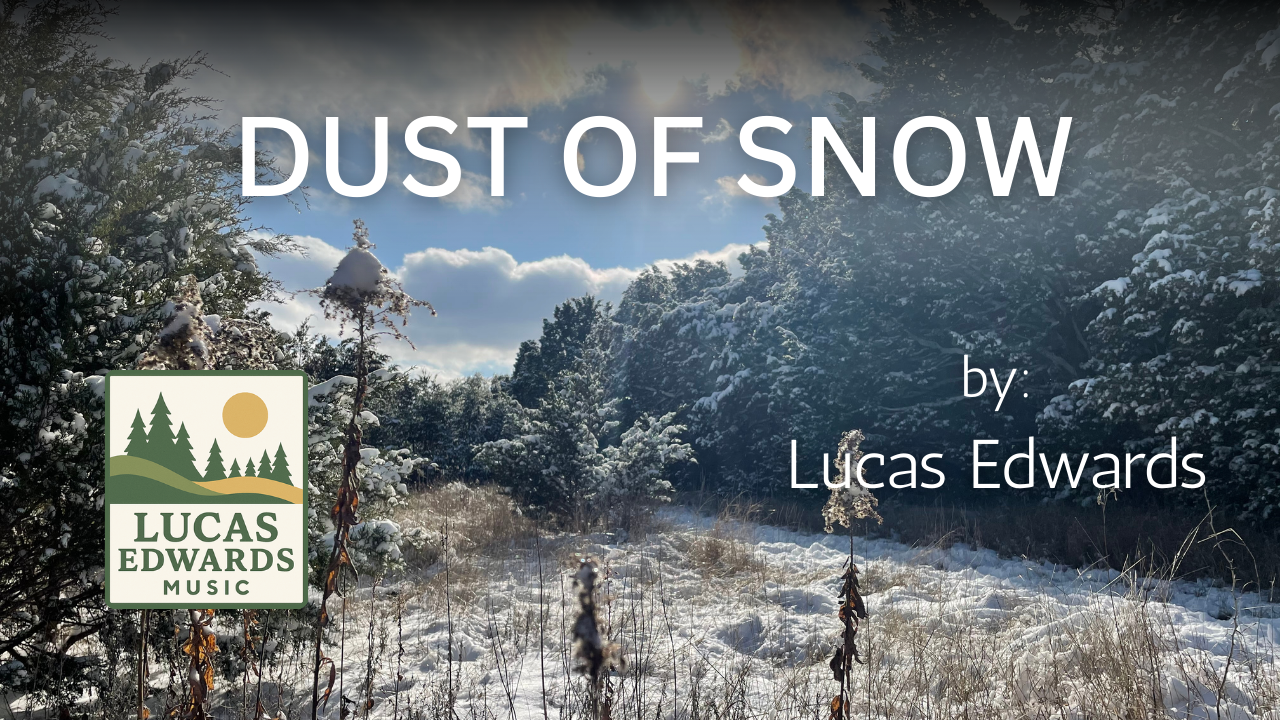
Dust of Snow is a setting of a Robert Frost poem. I set it as a chamber choir piece that is a capella. I use voices to set a scene of a solemn winter landscape.
Dust of Snow – Robert Frost (1874 – 1963)
The way a crow Shook down on me The dust of snow From a hemlock tree
Has given my heart A change of mood And saved some part Of a day I had rued.
-
This piece is a setting of the Emily Dickinson poem of the same name. The poem is purposefully not set to music in its completion because it is the introduction to my larger work called: Saining Songs
The Outlet (162): Emily Dickinson (1830 – 1886)
My river runs to thee: Blue sea, wilt welcome me?
My river waits reply. Oh sea, look graciously!
I'll fetch thee brooks From spotted nooks,—
Say, sea, Take me!
-
I got the idea for Stars while thinking about a very cold night I spent stargazing with friends. I remember the feeling of awe and wonder, while fighting the urge to run back to my warm sleeping bag. I came across the poem and wrote the piece in about a day, something that is very rare for me.
I saw no way, the heavens were stitched (378): Emily Dickinson (1830 – 1986)
I saw no Way—The Heavens were stitched— I felt the Columns close— The Earth reversed her Hemispheres— I touched the Universe—
And back it slid—and I alone— A Speck upon a Ball— Went out upon Circumference— Beyond the Dip of Bell
-
I knew I wanted to have a culminating piece for this project, but really fought to find the correct text and music for it. I had a chord progression and nothing else for a long time-at least 2 years. Two years ago, I was on a road trip from Texas to Colorado, and was reading Emily Brontë poetry, I came across her poem: “Ah! Why, because The Dazzling Sun”. It spoke to me very vividly. The edited poem is in the text section of the program, but I implore you to look up and read the full poem. In 2024, I started writing and it came together very quickly. I used a lot of melodic material from the other pieces in the project to give a sense of finality.
Ah! Why, because The Dazzling Sun (edited by me): Emily Brontë (1830 – 1986)
The soul of Nature sprang elate, But mine sank sad and low! O Stars and Dreams and Gentle Night; O Night and Stars return!
And hide me from the hostile light That does not warm, but burn— That drains the blood of suffering men; Drinks tears, instead of dew: Let me sleep through his blinding reign, And only wake with you!
The soul of Nature sprang elate, I was at peace, and drank your beams As they were life to me But mine sank sad and low!
-
I started writing this piece in early 2023. My outlets for my personal struggles are usually kept in my songwriting journal. However, as I read the text by Robert Frost- I instantly connected. The notion of struggling with forgiveness and realizing that living in the mistakes of others is not worth the struggle put on oneself is beautiful to me. Above that, it’s a withdrawal from oneself that ultimately leads to more suffering. This realization in my personal life was not a sudden “Pang” for me- this is reflected in the music. To me, it was a changing—morphing thought.
A Dream Pang: Robert Frost (1874 – 1963)
I had withdrawn in forest, and my song Was swallowed up in leaves that blew alway; And to the forest edge you came one day (This was my dream) and looked and pondered long, But did not enter, though the wish was strong: You shook your pensive head as who should say, ‘I dare not—too far in his footsteps stray— He must seek me would he undo the wrong. Not far, but near, I stood and saw it all
Behind low boughs the trees let down outside; And the sweet pang it cost me not to call And tell you that I saw does still abide. But ’tis not true that thus I dwelt aloof, For the wood wakes, and you are here for proof.
Instrumental
Piano and Viola
-
For Piano and Viola
This piece is named after a nature preserve in Austin, Texas. I used to live near the preserve and would often take walks there to decompress. After moving back home to the Los Angeles area, I realized that I had taken these small walks for granted. While I was writing this piece, I kept thinking of these walks, so I named the piece after this place.
-
For Piano and Viola
I associate this piece with a hiking trip I took to the Sierras in 2022. I remember a day in August with fog, and I had written a short song that I named August Fog. When I returned from the trip, I looked up August Fog and found a folk saying, or wives’ tale, that says “for every August fog, there will be a winter snow.” I thought it was a beautiful metaphor.
This is the first of a set of pieces for viola and piano, and it also opens my larger project, Saining Songs. I have been writing these viola pieces on and off since 2022. I wrote Goat Cave Karst first, and I enjoyed writing in this style so much that I decided to keep writing them. I had specific places in mind while writing all three of these pieces, and writing them quickly became an outlet for me to write simply pretty music.
-
For Piano and Viola
This piece is named after the walks that I take in the harbor near my family’s home in Long Beach. While traveling around Europe, I also always found myself feeling at home in harbors, probably because I grew up so close to the water. The sights and sounds of boats and docks always feel familiar to me.
Piano and Violin
-
For Piano and Violin
This piece reminds me of being on a precipice. It was written as an introduction to the next piece in Saining Songs, Stars.
String Quartet
-
For String Quartet
This piece is an ode to chamber music and to American folk music. Throughout my time studying music, I have researched folk music of Scandinavia, Ireland, the Baltics, and more. I always knew I wanted to write American music, but I’m glad I studied these other traditions thoroughly first. In some ways I didn’t, and still don’t, know exactly what American music is, but I think I’m coming to an understanding. My country is teeming with people from different cultures and ideologies, and one thing that I see connecting the U.S. is a love for innovation and nature. These set us apart, and I think the American artist’s job is to take risks and to connect to people where they want to meet. This piece hits a lot of different feelings, and I hope to write more things like it in the future.
Musically, I used broad voicings and techniques from many different traditions, including a fugue-like section.
Mixed instrument Chamber
-
For Piano, Violin and Clarinet
This piece is a study in Scandinavian folk music. It is a slow-moving, atmospheric piece that uses popular folk tunes and songs from different Scandinavian countries. The piece is named after a creature called the Nøk (Danish), or Nykkjen (Norwegian), which loosely translates to “water spirit.” The creature lives in lakes and ponds and sings to lure people to the water’s edge, where they are taken in by the Nøk and killed. The story varies heavily depending on where it is told, as there are similar creatures in many cultures. I see the creature as a personification of both the real danger of drowning in frozen lakes and the alluring nature of music and art. The piece is meant to fit the eerie feeling the creature imposes.
The first movement uses the melody “Drømde mik en drøm i nat,” which is the oldest written secular song from Scandinavia. The second movement has lyrics from a Norwegian folk song called “Heiemo og Nykkjen” about the creature.
-
For Piano, Violin, Clarinet, Trombone, and Bass Drum
The second movement of Nøk sets lyrics from a Norwegian folk song called “Heiemo og Nykkjen,” about the Nøk, or Nykkjen, a water spirit that lives in lakes and ponds and sings to lure people to the water’s edge. (See Nok I for the full program note.)
Lyrics (from “Heiemo og Nykkjen,” Norwegian folk song)
Her ligg du, nykkjen, fyr ravn og hund
- Vakna dikko ædelege drenge
Enno hev eg min kve'arlund.
- For de hev sovi tidi så lengjeHere you are, water spirit, laying for raven and dog.
- Wake up noble boys!
I still have my singing grove.
- Cause you’ve been sleeping too long
-
For Vibraphone and Alto Saxophone
I wrote this piece for Bent Frequency, a saxophone and percussion duo who came to CSUF in Fall 2024. The instrumentation of pitched percussion and saxophone gave me a unique opportunity. Despite being a “percussion” instrument, the vibraphone is a very melodic instrument that excels at playing melodies. I used this piece as a melody-writing experiment of sorts.